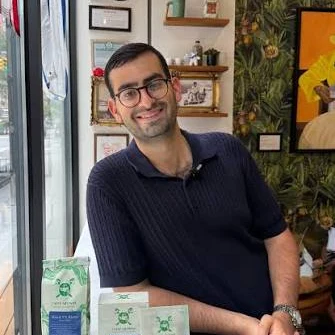
The stores that care are still here.
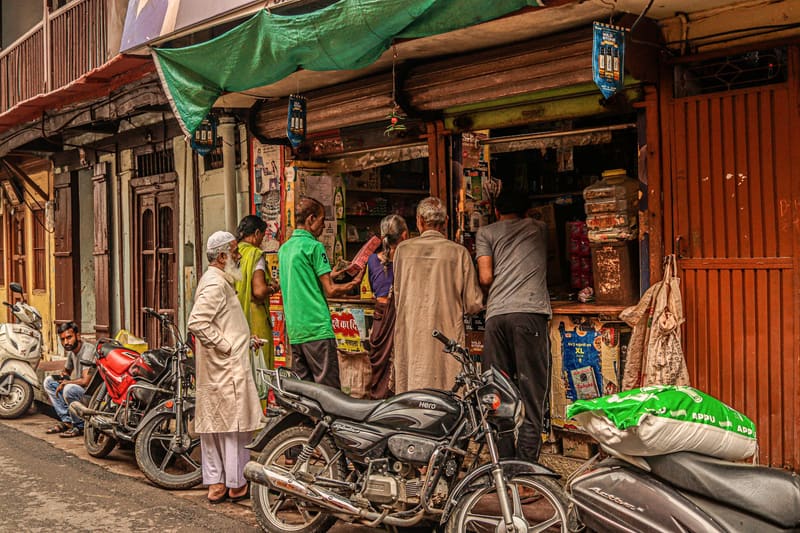
We’re building for the store, and the person behind the counter.
Bengaluru was a market before it was a city
In 1537, Kempegowda ploughed four furrows with four pairs of white bulls and marked out the land inside them. What he built there was a market with a fort attached.
The streets were named after what they sold.
- TaragupeteGrain
- BalepeteBangles
- ChikkapeteCloth
- NagarthpeteCloth
- TigalarapeteFlowers
- CubbonpeteTextiles
If you needed rice, or a drum, you knew which street to walk to and who would be selling it. Five hundred years later, people still go to Chickpete for cloth.
Every great city grew this way: the stores came first, and the city arranged itself around them.
The stores kept up. We lost track of them
From the start, the store was how a city looked after itself. Whatever the people living in it needed, someone was selling it, a short walk away.
Then the city grew, and so did the list. Rice and cloth turned into single-origin coffee, sourdough, gochujang, grain-free dog food and watercolour paper in three weights. The stores kept up with all of it. Somewhere in Bengaluru, someone already stocks each of those things and knows more about them than you’d expect.
What changed was us. The city got too big to hold in your head. We stopped knowing which street, which store, which person. Online made finding things easy, and we did what people have always done. We took the easier route.
We don’t blame anyone for that. We just think the stores deserve to be that easy too. Pikvita is our attempt at making them as easy to shop from as anything on your phone.
Every shelf is somebody’s opinion
Ask anyone who has stood behind a counter.
A store is a place where somebody has taken a position. The owner chose this rice and refused that one. He stocks the expensive cinnamon because he thinks you should taste the difference. She keeps three kinds of thread because one customer asked for it years ago and she never forgot.
That’s judgment, built up over years and available to anyone who walks in.
And a store is a place where you are a person. The psychologists have a name for this, which is funny, because your grandmother never needed one. Gillian Sandstrom and Elizabeth Dunn found that people who exchanged a few words with their barista left happier and felt more connected than people who didn’t. Small, forgettable exchanges with people we barely know turn out to be a real part of how we belong to a place.
A city is made of those exchanges: the vegetable seller who knows your mother, the pharmacist who asks about your knee, the man at the bakery who keeps one aside because he knows you come at six. Take them away and the city still works, but it stops feeling like yours.
What a dark store takes with it
Our problem is with what we’ve been asked to give up for speed. When a store is replaced by a room with no windows, no name and no one behind the counter, here is what goes with it.
You lose a story. Somebody spent twenty years learning how to buy tea, and that knowledge doesn’t get uploaded anywhere. It just stops.
You lose a place to go. You can’t walk into an app, and you won’t run into your neighbour in a warehouse.
And you lose someone to ask. A shopkeeper has to see you again tomorrow, which is the oldest quality check there is. When a product from a warehouse is wrong, there’s no one whose name is on it.
The things worth having still come out of stores.
Stores are still the larger half of the economy
India has somewhere between 12 and 20 million stores. They carry roughly three quarters of what the country buys. They are about a tenth of GDP and employ close to a tenth of the workforce.
These stores are the working economy, and they’re being asked to compete with enormous amounts of capital built specifically to replace them. Almost none of that money has gone into helping the stores themselves get their shelves online, keep their stock up to date and sit a few taps away from the people who live nearby. The stores need help catching up, and that’s the work we want to do.
Caring got harder than not caring. That’s a problem we can fix.
What we believe
- Every store is worth something. Whether it has one counter or fifty branches, if someone is behind it trying to sell something good, we’re on their side.
- Not every store belongs on the app yet. The app is where we put the stores we’d send a friend to. The infrastructure we’re building is for all of them.
- Retail is a craft. Choosing what to sell, to whom and at what price is a skill people spend a lifetime getting good at. It deserves the respect we give any other craft.
- Everything you need is inside your city. It’s already here, on a shelf in someone’s store a couple of kilometres away.
- Stores should be the normal way people store. Right now they’re what people choose when they have time to spare. We want them to be the first place people look.
- A store has to be findable. A store can do everything right and still lose because nobody knew it was there. That’s the problem we work on.
What we are building
Make stores findable.
Put real stores in front of the people nearby who’d choose them, with their names on them, their stories attached, and their shelves a 60 to 120 minute delivery away. This is what Pikvita is today.
Give stores the infrastructure they never got.
Software built for a person who runs a store and doesn’t want to become a technology company. Catalogue, orders, delivery, payments and a way to reach customers. The tools a chain buys with a budget, available to a store with one counter.
Connect every store in the country.
The stores wouldn’t be owned by us or branded as us. Any store in any city could be found, ordered from and delivered from, without giving up what made it worth finding.
We are early. Right now it’s one app, two neighbourhoods, HSR Layout and Harlur, and a list of stores we have walked into ourselves. We know what that is against 20 million stores. We’re going to keep going anyway.
Some lights have always been there. We’re just helping you find them.
Sources: Bengaluru Pete · CB Insights on kirana retail · Sandstrom & Dunn, Social Interactions and Well-Being